


2026
Life through a screen
View Online

Sign up for a six month free
trial of The Stand Magazine!
During the American founding era, week after week, on Sunday mornings, the congregation members would arise and recite together The Apostles’ Creed, a historic statement of the Christian faith. Often it was written on the walls.
Who participated regularly in such affirmation of their faith? George Washington, Patrick Henry, Thomas Jefferson, James Madison, and so on. For example, at Bruton Parish Church in Williamsburg, Virginia.
The Congregationalists, such as Samuel Adams, John Adams, John Hancock, and Roger Sherman, also affirmed their faith in the divine Savior, Jesus Christ, in their own Bible-based churches.
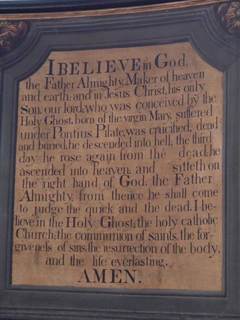
(Here is a photo I took at Trinity Episcopal Church in Newport, Rhode Island, showing the Apostles' Creed.)
The outline of the Apostles’ Creed is quite simple – it highlights the Trinity. It affirms belief in God the Father, the Son of God (Jesus), and the Holy Spirit. It’s called the Apostles’ Creed because it is based on the teachings of the Apostles.
A more elaborate statement of faith was created exactly 1700 years ago in 325 AD. It is the Nicene Creed. It too has the same basic outline: the Father, the Son, and the Holy Spirit. But it helps elaborate further on the deity of Christ.
Two decades ago, The Da Vinci Code, a novel set against a supposedly historical backdrop, took the nation by storm. If it were viewed as 100% fiction, no problem. But it claimed to be based on true history. And that is incorrect.
The Da Vinci Code attacked the deity of Christ, whom they claimed was not believed to be divine until three centuries after His crucifixion (and resurrection, which, as I recall, isn’t mentioned in the novel). The book claims that Jesus was not declared divine until the Council of Nicaea in 325 AD. And supposedly, the vote at the Council was “close.” Total hogwash.
For the record, when the Emperor Constantine claimed to be a Christian in 312 AD, he was the first to make Christianity legal.
Now that the Christians could emerge from the catacombs, some doctrinal conflicts that had been simmering all along came to the forefront.
Was Jesus inferior to the Father? Was He “made” as opposed to “begotten”? That is, was He a created being, even if He was in some way divine? Was there “a time when He was not”? Arius (d. 336), a presbyter (elder) of Alexandria, believed that that was the case.
Constantine called for a council to resolve these issues to take place in a town close to Constantinople, Nicaea.
At the Nicene Council 1700 years ago, 318 bishops voted to adopt the Nicene Creed. Only two did not vote for it. But for the next half century, acceptance of the Nicene Creed was not universal. Special thanks to Athanasius (d. 373), who was the great champion of the creed, despite the cost to him personally.
Finally, at the Council of Constantinople in 381, the church leaders agreed to accept the Nicene Creed with a few minor tweaks. And thus, for centuries, Christians have been affirming what the Bible teaches. That Jesus is divine. That there is only one God, but He exists in three Persons, the Father, the Son, and the Holy Spirit.
In the part about Jesus, the Nicene Creed states:
“We believe in one Lord, Jesus Christ, the only Son of God,
eternally begotten of the Father, God from God, Light from
Light, true God from true God, begotten, not made, one in
Being with the Father. Through him all things were made.”
Those words are very specific. Virtually every phrase was carefully hammered out. Nothing was simply accepted without a fight.
What does the Scripture—a first-century witness—say about these things?
Christmas is so special because that baby in the manger was not just a little baby boy. He was also divine. No wonder wise men, including many of our founding fathers, have affirmed this incredible claim.
###
Jerry Newcombe, D.Min., is the executive director of the Providence Forum, an outreach of Coral Ridge Ministries. He has written/co-written 33 books, including George Washington’s Sacred Fire (with Providence Forum founder Peter Lillback, Ph.D.) and What If Jesus Had Never Been Born? (with D. James Kennedy, Ph.D.).

Sign up for a free six-month trial of
The Stand Magazine!
Sign up for free to receive notable blogs delivered to your email weekly.